Princeton
The Boys in the BoatPrinceton becomes the crucial eastern setting in the Washington crew’s final qualification for the 1936 Olympics: a place where the boys confront the class privileges surrounding collegiate rowing, race for the right to represent the United States, and learn that victory alone may not secure their passage to Berlin. The stately Princeton Inn, the purpose-built Lake Carnegie course, and the demand that the rowers finance their own trip place athletic achievement inside a larger contest over access and resources.
A stage shaped by collegiate rowing
Princeton enters the story as a destination on the route from the Pacific Coast to the Olympic trials. Al Ulbrickson’s plan was to take the varsity first to the Pacific Coast Regatta on Lake Washington, then to the June championships at Poughkeepsie, and finally to Princeton in July. A win at Princeton would mean a trip to Berlin, followed by further qualification and the Olympic gold-medal race. The sequence made the town more than a venue: it was the last major threshold between a season of domestic competition and the prospect of racing the world’s best crews.
That threshold stood within a sport whose resources and reputation were unevenly distributed. Eastern colleges had long dominated the Intercollegiate Rowing Association regatta, while western crews faced the expense of transporting both rowers and delicate racing shells across the country. When western teams did make the journey, they met curiosity, condescension, and sometimes derision from audiences more accustomed to seeing the sons of senators, governors, industrialists, and presidents than the sons of farmers, fishermen, and lumberjacks. Princeton’s setting gives that divide a material form: its cultivated grounds and costly rowing facilities contrast with the working-class backgrounds of the Washington boys.
The Inn, the lake, and the class divide
The crew arrived at Princeton on July 1 after loading the Husky Clipper onto a baggage car in Poughkeepsie. They had entered a world of status and tradition that felt uncertain but intriguing to young men from working-class families. They stayed at the Princeton Inn, beside the manicured fairways of the Springdale Golf Club, and watched alumni in knickerbockers, high argyle socks, and tweed caps stroll across the grounds. The hotel and country-club surroundings offered a striking contrast with the boys’ more modest homes.
They explored Lake Carnegie and the Princeton Boathouse, a large stone building with Gothic arches over its boat bays. To the Washington rowers, it was more elegant than the clapboard homes familiar to them and far removed from their old airplane hangar of a boathouse. The comparison made privilege visible not as an abstraction but as the surroundings in which a crew trained and competed.
Lake Carnegie itself embodied that advantage. Princeton crews had once rowed on the Delaware and Raritan Canal, where coal barges and recreational vessels shared the water. Finding that traffic inconvenient, Princeton’s rowers secured a private course: Andrew Carnegie bought properties along a three-mile stretch of the Millstone River, dammed it, and created a shallow, straight, protected lake without coal barges. The project cost roughly one hundred thousand dollars. Its calm, purpose-built course stood in contrast to the compromises faced by less affluent programs.
The Olympic trials on Lake Carnegie
For the first few days, the Washington crew enjoyed the hotel and country-club setting while preparing for the trials. Don Hume was trying to shake a bad cold; the crew took light workouts twice daily and practiced high-rate sprints and racing starts, a critical element of the 2,000-meter distance that had recently troubled them. Six crews were competing for the Olympic place: Washington, California, the University of Pennsylvania, the Navy, Princeton, and the New York Athletic Club. The preliminary heats were set for July 4, with the top two crews in each advancing to a four-boat final the following day.
The heat and the stakes unsettled the Washington rowers before the opening race. On the night of July 3, they had trouble sleeping in the damp, sultry weather. Ulbrickson went from room to room telling them to settle down, while Joe Rantz and Roger Morris stayed awake joking and telling stories. The Washington crew was not especially worried about its preliminary opponents, Princeton and the New York Athletic Club, but the possible final field was harder to read. Other crews had added recent graduates or changed coxswains; Washington alone consisted entirely of undergraduates.
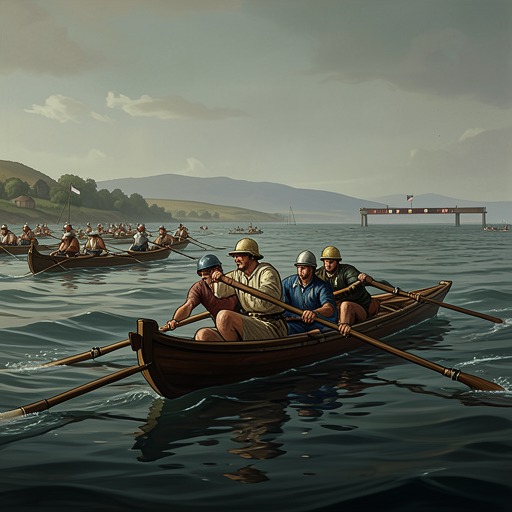
On July 4, several thousand spectators gathered along Lake Carnegie for the qualifying heats. Washington started at a rate of thirty-eight strokes per minute. After about a minute Bobby Moch told Hume to bring the rate down, first to thirty-four and then to thirty-two. The Husky Clipper nevertheless held the lead and widened it. When the New York Athletic Club made a late challenge, Moch had Hume raise the rate again to thirty-eight; Washington finished two and a half lengths ahead. The ease of the win surprised even the crew. They moved out of the racing lanes and waited along the bank to see how California would fare.
The final and its consequences
In the final, Washington faced the University of Pennsylvania and California. Hume and Rantz set a long, fluid rhythm at thirty-four, and the rest of the crew followed in unison. As the boats approached the final stages, Washington moved past California and drew alongside Pennsylvania. With fewer than five hundred meters remaining, Moch finally sent the crew into a higher-tempo drive. Washington’s rate climbed to thirty-nine and then forty; the boats contested the lead for several strokes before Washington pulled ahead. The crew crossed the line a full length in front of the University of Pennsylvania, with the margin still growing. Moch stood upright in the narrow shell and thrust a fist into the air. California finished third, while the New York Athletic Club crew came in far behind, several of its rowers collapsed across their oars in the heat.
The victory established Washington as the crew that had won the right to go to Berlin, but Princeton also became the setting for a sudden financial reversal. At the Loyal Shoudy banquet that night, the boys found the traditional purple necktie and five-dollar bill at each place setting. As they celebrated, rumors spread that the crew might have to pay its own way to the Olympics. Henry Penn Burke then told Ulbrickson, George Pocock, and Washington athletic director Ray Eckman that five thousand dollars had to be raised by the end of the week or the University of Pennsylvania, the second-place finisher, would take Washington’s place.
The demand exposed how fragile the Washington crew’s opportunity remained. The university had already scraped together money from alumni and Seattle residents to send the boys east; the rowers themselves could not supply the fare. The next day, Seattle’s fundraising effort gathered contributions from businesses, civic groups, and the crew members’ hometowns. Donors ranged from the Seattle Times and Standard Oil to a beer parlor, an anonymous contributor, and Cecil Blogg, one of Hiram Conibear’s former coxswains. By the end of the second day, a certified check for five thousand dollars was on its way to Ulbrickson. The crew departed Princeton and prepared to train at Travers Island before sailing to Germany.
Princeton thus holds together two sharply different measures of qualification. On Lake Carnegie, the Washington rowers demonstrated that they could beat their rivals at the Olympic distance; in the negotiations at the Princeton Inn, their right to convert that performance into an Olympic berth depended on money they did not possess. The place’s elegant facilities and the funding ultimatum sharpen the same contrast: sporting access could be earned on the water, yet the journey onward still depended on resources beyond the crew’s control.